
Indian stock market benchmark indices Sensex and Nifty experienced a significant decline, driven by escalating tensions in the Middle East and rising crude oil prices.

Indian markets on Dalal Street rallied sharply as easing tensions in the US-Iran conflict and stable oil prices boosted sentiment. Track Nifty 50 and BSE Sensex performance and key global triggers.

Ongoing geopolitical tensions in West Asia have slowed deal momentum in Dubai's luxury residential market, but Indian high-net-worth individuals (HNIs) are not exiting their marquee assets, with any 'discounted' resale deals attributed to investor liquidity stress rather than geopolitical flight.

The precious metal had gained Rs 435 in the previous three sessions.

Indian equity investors experienced a significant loss of 16.32 lakh crore due to a two-day stock market decline fueled by escalating geopolitical tensions involving the US, Israel, and Iran.

Bharti Airtel was the top loser in the Sensex pack, slipping around 1 per cent, followed by Tata Steel, HDFC Bank, Infosys, HDFC, Bajaj Auto and PowerGrid.

In an event-heavy week ahead, stock markets are expected to track Q3 corporate earnings from several blue-chip firms, including TCS and Infosys, while inflation data and global trends would also dictate investors' sentiment, analysts said.

With a confident new generation of innovators, India now has the scale and self-belief to shape its own digital destiny marked by creation, observes Ajay Kumar chairman, UPSC.

As Jana Nayagan and Avatar: Aang, The Last Airbender become victims of piracy even before they got an official release, Sreeju Sudhakaran looks back at some of the major Indian movies that were impacted by pre-release leaks.

Indian tennis icon Leander Paes has joined the Bharatiya Janata Party (BJP), marking a significant transition from his celebrated sports career to the political arena, ahead of assembly elections in West Bengal.

Migration from Kerala has become a significant issue in the upcoming Assembly elections, with political parties promising to create more opportunities within the state to discourage emigration for studies and jobs. Experts suggest focusing on 'brain gain' strategies to attract talent back to Kerala after gaining experience abroad.

After gaining Rs 75 in the previous session, the precious metal advanced further, driven by a firming trend in overseas markets as US economic data signalled the Federal Reserve may continue its asset purchase program to support the recovery.

Among the Sensex stocks, Bajaj Finance, Bajaj Finserv, Sun Pharma, IndusInd Bank, Tata Motors, ICICI Bank, Tata Consultancy Services, Hindustan Unilever and Power Grid were the major gainers. NTPC, Axis Bank, Nestle, HCL Technologies and HDFC Bank were the major laggards.

Kerala's 2026 assembly election will see a three-cornered contest where religion and communalism have emerged as central themes for the first time, challenging the state's long-celebrated secular fabric.

Sukanya Verma shows you how you can rock the dreamy white shade in all its stylish avatars to survive the scorching heat.

Foreign portfolio investors (FPIs) withdrew a substantial amount from Indian equities in the first half of March, driven by geopolitical tensions, rupee depreciation, and concerns about crude oil prices.

Indian equities on Dalal Street saw volatility. Track Sensex, Nifty50 movement and key market drivers for Feb 25, 2026.

The Indian rupee weakened against the US dollar due to rising crude oil prices, geopolitical tensions in the Middle East, and foreign fund outflows.

Traders said profit selling by stockists emerged after a rally in the previous session mainly pulled down gold and silver prices.
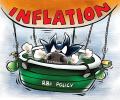
The Indian government has extended the Reserve Bank of India's (RBI) mandate to maintain retail inflation at 4 per cent, with a tolerance band of 2 per cent on either side, for another five years until March 2031.

The Reserve Bank of India (RBI) has introduced its 'Payments Vision 2028' document, outlining initiatives to enhance digital payment security, introduce electronic cheques, and expand regulatory oversight to include e-commerce entities.
Indian benchmark equity indices Sensex and Nifty experienced a significant crash in early trade, triggered by a sharp increase in crude oil prices and escalating tensions in the Middle East.

Shares of tyre manufacturers have outperformed broader equity benchmarks, buoyed by multiple tailwinds. Softer raw material prices, an uptick in demand from automakers following the reduction of the goods and services tax (GST) rates, and steady replacement demand have lifted sentiment toward the sector.

Inflation data, quarterly earnings and global trends will be the major driving factors for stock markets this week, analysts said. Moreover, the trading activity of foreign investors would also influence the equity market trends.

Benchmark indices finished on a weak note on Thursday, extending their previous day's decline amid a negative trend in global equity markets after the US Fed hiked interest rates by 75 basis points. The 30-share BSE Sensex declined 69.68 points or 0.11 per cent to settle at 60,836.41. During the day, it tanked 420.95 points or 0.69 per cent to 60,485.14.

Global cybersecurity firm Kaspersky plans to significantly increase its investments in India, leveraging the country as a hub for regional services due to strong financial performance and the escalating threat landscape.

A new survey indicates that Indian employers are planning to increase hiring in the April-June quarter, driven by strong business confidence and domestic demand. The survey also highlights the impact of AI adoption on workforce strategy and the challenges of talent scarcity.

Indian banks are urging the Reserve Bank of India (RBI) to reconsider its new $100 million cap on net open foreign-exchange positions, warning that the directive could lead to significant mark-to-market (MTM) losses and force an accelerated unwinding of trades, potentially impacting FY26 earnings.

Gold plunged by Rs 120 to Rs 30,810 per ten gram, while silver lost Rs 280 to Rs 49,670 per kg on falling demand among industrial units and coin makers.

The outreach comes amid a drop in Indian student enrolments in management programmes at American universities last year, following changes to US student visa policies.

For decades, multinational pharmaceutical companies and Indian drugmakers worked in ways that supported each other: MNCs brought innovation and brands, while Indian companies built scale through generics and cost efficiency. There was an important overlap - generic drugs - but this is shrinking fast. And the consequences are reshaping India's gigantic pharmaceutical market.

Among Sensex firms, Tata Steel, Eternal, UltraTech Cement, Larsen & Toubro, Maruti and Bharti Airtel were the major gainers. However, Hindustan Unilever, Sun Pharma, ITC and Asian Paints were among the laggards.

India contributes roughly 10 per cent of Samsung Electronics' global revenue and hosts over 10,000 engineers across its R&D centres.
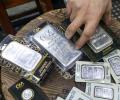
Silver prices extended their record-breaking rally for a sixth straight session on Monday, surging 6 per cent to touch a lifetime high of Rs 2,54,174 per kilogram in futures trade amid strong investor demand and bullish global trends. On the Multi Commodity Exchange (MCX), silver futures for March delivery surged Rs 14,387, or 6 per cent, to hit a new record of Rs 2,54,174 per kilogram.
Benchmark equity indices Sensex and Nifty tumbled in early trade on Wednesday, tracking a bearish trend in Asian markets, as the conflict in West Asia widened, driving oil prices higher.

The message is becoming clearer: Employees who fail to meaningfully integrate AI into their work risk falling behind in performance assessments.

There is record underperformance and under-ownership. Some of this is cyclical and will turn on its own. However, we also need to regain our growth credentials. For this, both the government and companies have a role to play, as do investors, points out Akash Prakash.

The OnePlus 15T has been officially listed in OnePlus/OPPO's China store and is set to launch on March 24, 2026, marking its entry as a compact flagship focused on performance and battery life.

The verdict marks a notable shift from a series of recent wins for Trump at the Supreme Court.

India's merchandise exports experienced a slight decrease in February, while imports surged due to increased gold and silver purchases, leading to a widened trade deficit. The West Asia crisis is expected to further impact trade in the coming months.
